
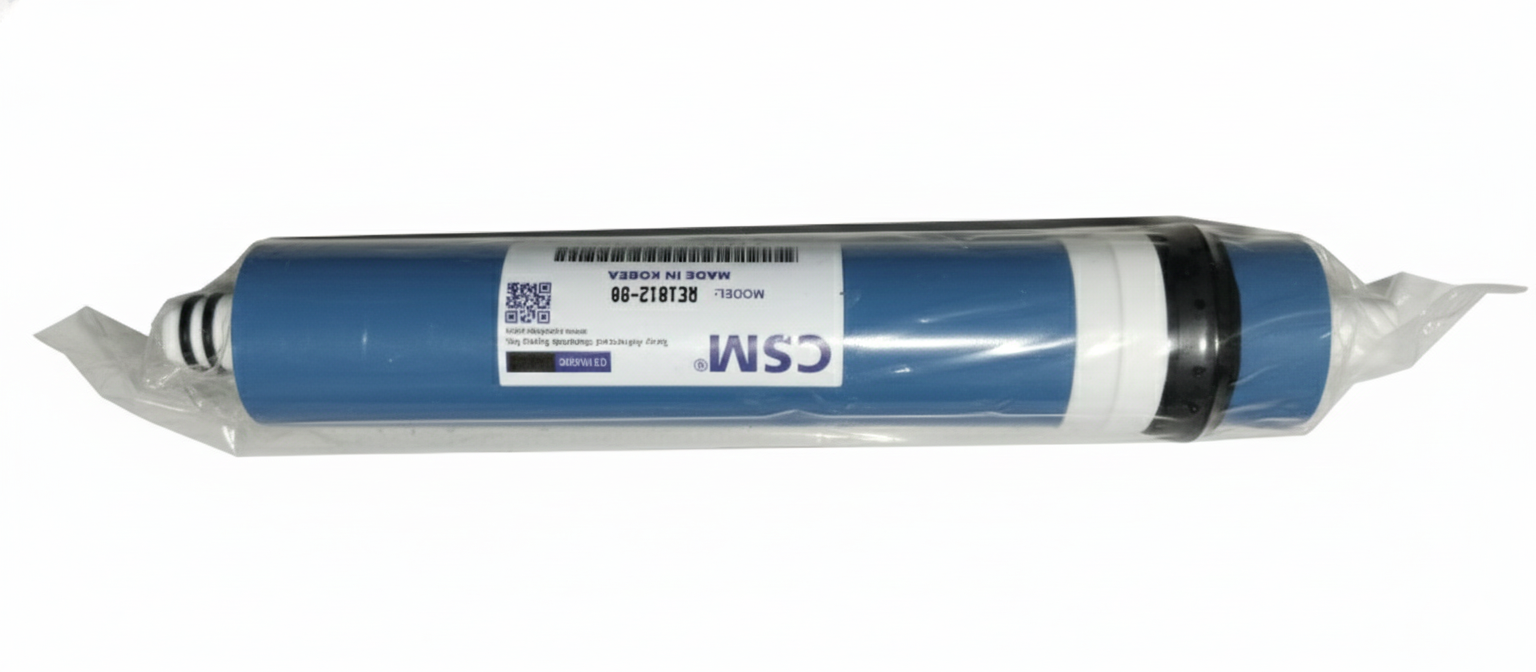
RO Membrane
The Core Engine of Pure Water: 0.0001-Micron Separation
Rejects 92% to 96% of dissolved salts, heavy metals, lead, and fluorides under high booster pressure
Inclusive of 18% GST • Free standard delivery on orders above ₹499
How It Works Inside Your Water Purifier
Role in the Purification Chain
The reverse osmosis membrane is the microscopic heart of your purifier. It uses spiral-wound Thin-Film Composite (TFC) sheets that permit only pure H2O molecules to pass, flushing dissolved arsenic, lead, fluoride, and hardness out the drain line.
Physical & Mechanical Principle
Operating under 70 to 100 PSI booster pump pressure, feed water is forced across dense polyamide sheets. With pore sizes of 0.0001 micron (500,000 times smaller than a human hair), it achieves physical molecular separation without chemical additives.
Technical Specifications & Dimensions
How to Spot Genuine vs Local Copies
The 'Your Membrane Is Dead' False Alarm
Technicians frequently declare the expensive membrane ruined whenever water flow slows down, billing ₹2,500 to ₹4,000. In reality, 80% of slow-flow issues are caused by a clogged ₹90 spun filter or a choking ₹40 Flow Restrictor.
Always check water flow exiting the carbon filter first. If good pressure enters the membrane but nothing exits, test output TDS. Only replace if TDS rejection has dropped below 85%.
5-Minute Step-by-Step DIY Installation
Isolate Water & Power
Turn off inlet tap and unplug machine from wall outlet.
Open Membrane Housing
Disconnect inlet tube and unscrew the housing cap with a spanner or hand grip.
Extract Old Membrane
Grip the central stem with nose pliers and gently pull outward with a twisting motion.
Clean Housing Interior
Rinse inside of the housing with clean water to remove settled mineral silt.
Seat New Membrane Firmly
Lubricate dual O-rings with water and push the new membrane firmly until it locks fully into the bottom seat.
Replace Flow Restrictor & Flush
Always clip in a fresh FR 450 valve on the reject pipe. Flush first 10 liters to drain before drinking.
Watch Video Demonstration
How to Replace an RO Membrane in 10 Minutes (Step-by-Step)
Complete walkthrough showing housing opening, old element extraction, O-ring seating, and initial flushing procedure.
Universal Purifier Compatibility
Standard 1/4" push-fit ports and certified dimensions guarantee full plug-and-play compatibility with all popular water purifier brands sold in India:
Frequently Asked Questions
How often should an RO membrane really be changed?
Every 2 to 3 years under typical municipal water, or when tested salt rejection drops below 85-90% of raw input TDS.
Why should I replace the Flow Restrictor when changing the membrane?
A worn or clogged FR valve alters back-pressure. An old clogged FR causes the pump to strain and will rupture your brand new membrane within months.
Do I need tools to replace the membrane?
Only a pair of nose pliers to pull the old cartridge out of the tight housing cylinder.